Capital Zone

mortgage brokers

joint mortgage

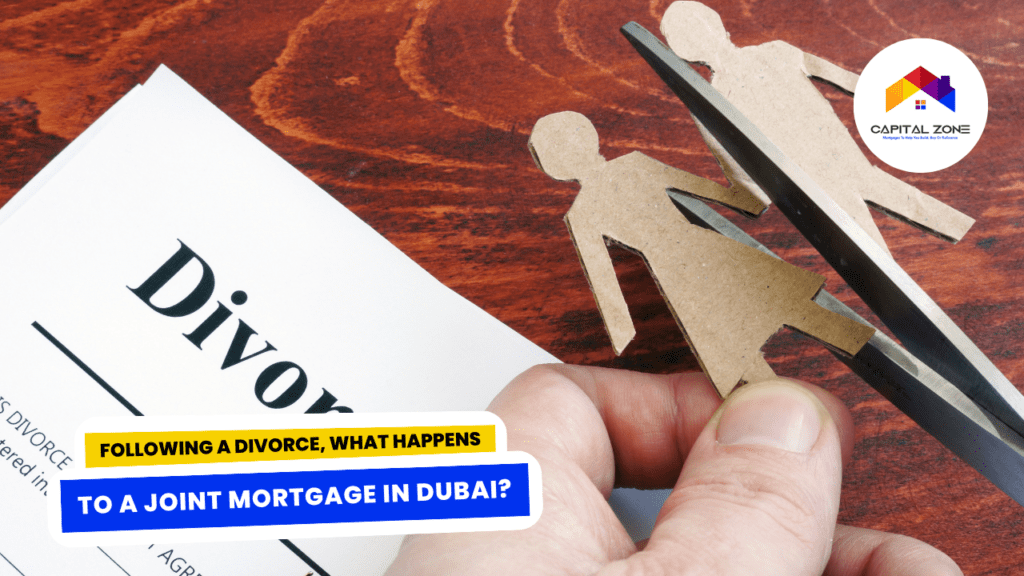
Following a divorce, what happens to a joint mortgage in Dubai?

When a couple decides to end their marriage, the question of what happens to their joint assets, including their home, is a major concern. For many couples, a home mortgage is one of the largest debts they will have to navigate in the divorce process. In Dubai, there are specific laws and regulations regarding joint mortgages and their division in case of a divorce. In this article, we’ll explore what happens to a joint mortgage after a divorce in Dubai and what options are available for both parties – When it comes to joint mortgages in Dubai, it is essential to understand the legal implications of the divorce settlement. In some cases, the settlement may require both parties to continue making mortgage payments until the mortgage is fully paid off. In other cases, the settlement may require one party to pay off the mortgage in full. It is essential to work with a mortgage advisor to understand the specifics of your situation and to determine the best course of action. It’s also critical to note that if the mortgage is in arrears or if the property is in negative equity, the situation can become more complicated. If the mortgage is in arrears, both parties will still be liable for the payments until the arrears are cleared. In cases of negative equity, both parties will be responsible for any outstanding mortgage payments, even if the property is sold for less than the outstanding balance. Related Articles: 1. Partner with a Mortgage Specialist in Dubai- Achieve your goals2. Getting a Mortgage Pre-approval in Dubai Stay tuned for more fascinating insights on UAE Mortgage trends:Website | Linkedin | Instagram | Facebook 

Following a divorce, what happens to a joint mortgage in Dubai? Read More »

snagging list

What to include in your snagging list?

So, you’re down to counting the last few weeks until the big move-in? It won’t be long until you finally settle in so give yourself a good pat on the back for us. Way to go! No home is fundamentally perfect. Yes, even brand new ones. There is always room or a possibility for human error. While the majority of homes for sale in Dubai are usually built with high standards of quality, safety and design in mind, a lot of things can be overlooked during the construction process.  If you are like us, you would not want any unpleasant surprises on the actual move-in day. To make sure to be sure there are no setbacks at the last minute, you’ll need a final quality check. You might have heard of the word ‘snagging’ before. And you’re probably hearing it more often now that the property handover is just around the corner. If you paid little or no attention to it then, it’s time you do so today. What is snagging? An informal term in the construction and property management industry, snagging, or a snagging survey, is a final inspection to check flaws, omissions or shoddy workmanship, called snags, before the final sign-off of a newly built home, especially off-plan properties. As a last-step inspection to ensure your home is flawless, it is done to flag defective, broken, or unfinished items to the developer for rectification.  Snags can be related to air-conditioning, electrical, and plumbing systems of the property or any civil or structural defect. They can range from minor and cosmetic to significant and structural issues. Flaked or uneven painting and ill-fitting doors and windows to defective appliances and fixtures are just some examples. Is snagging necessary? Buying a home is a major expense. Most likely, you purchased the property through a mortgage with monthly payments to meet. That in and of itself is reason enough to avoid added expenditures, especially if it is something you can prevent.  This is the case for snagging. While they may seem like minor faults, they can create more serious problems and become larger repair bills down the line.  Some snags are easy to spot, others are inconspicuous. This is especially true for homeowners who are not planning on occupying the property right away. This is because some issues only surface after the move-in day. By this point, developers may no longer accept rectifications. As a result, new homeowners are left with no choice but to shoulder the expense themselves.    So before signing off, the onus is on you to cast a critical eye and ensure that your home is not only well built as per the agreed standards but safe and structurally sound as well. Snagging is well worth the investment and it is crucial to place it on your priority list.  What to include in your snagging list? Knowing as much as you can about what to inspect can make the process easier and more efficient. This is where a snagging list comes in handy to ensure you are not forgetting key items and areas to check methodically. Below are the essential items that should be a part of your snagging list: Mechanical, electrical and plumbing components Air-conditioning Lighting systems including all the sockets and switches  Taps, pumps and water heaters Carpentry Doors and windows Cabinets Locks and hinges Civil and structural Painting Tiling Sloping in bathrooms External and internal walls Appliances (if applicable) White goods including the refrigerator, washing machine, dishwashers, etc. Your new home is an investment, one you should be proud of instead of the one you end up regretting. When doing the final inspection of your home, make sure your snagging list is thorough so that the inspection goes without a hitch and you are pleased with the final outcome. While you may have the ability to conduct a snagging survey yourself, many homeowners do not have the experience or are not fully qualified to carry it out on their own. A comprehensive inspection requires a trained eye and a wide range of hi-tech tools and equipment to cover all areas of the property.  Related Articles1. 3 Strategic Approaches To Real Estate Investment In Dubai2. Following a divorce, what happens to a joint mortgage in Dubai? Stay tuned for more fascinating insights on UAE Mortgage trends:Website | Linkedin | Instagram | Facebook 

What to include in your snagging list? Read More »

best Home Loan Deal

Discover the Best Home Loan Deals in the UAE Market Today!

This is a question we always get asked by our clients. Unfortunately, the “best deal” for a home loan does not exist. The best deal for one person’s circumstances may be very different from the next person’s. The lending process in the UAE is typically broken down into two main options. A fixed-rate mortgage or a variable-rate mortgage: which option is better for an individual will depend on their plans for the property, their appetite for risk, and if they have experience in the property market. The breakdown of these options is shown below – Fixed Rate Typically, the banks will offer a fixed rate for a duration of 1-5 years. During this period, the interest rate you pay and the monthly mortgage payments will not fluctuate. After the fixed rate period, the rate reverts to a variable product. This is typically made up of the bank’s profit plus an EIBOR rate (normally three months’ EIBOR, but this varies by bank). Once you come out of the initial fixed-rate period, you have a number of choices – Once you have completed your fixed period, Capital Zone Representatives will assist you in making this assessment. Fixed rates are good for those who are risk-averse and would like to budget for their expenses. You may pay a higher rate to guarantee the security of fixed payments. NOTE: There are no fixed rates for the duration of a mortgage in the UAE. If you hear this, look into what is being offered. Variable Rate These hold no fixed elements. Your loan will start at a rate that can fluctuate from the outset. Your deal will be made of bank profit plus Eibor (in most cases). Your payments will go up if the interest rates in the region increase; however, you could also benefit from rate reductions if the rates come down, as long as the lender does not put a cap on the minimum rate. Variable rates are good for those looking to pay the lowest bank margin and who are not concerned with budgeting for their monthly payments. Other factors to look into with your Capital Zone representative when taking a loan – Processing Fee Lenders with special offers running will sometimes offer zero processing fees; these are not the norm, however. Typically, banks will offer from zero to one percent of the loan amount as a processing fee. Overpayments Lenders will allow you to make lump-sum overpayments in order to close your loan faster. Each bank has a slightly different policy on this. Some will charge you 1% for any overpayments, while others will allow up to 30% of the outstanding balance to be repaid each year with no charge. If you have plans to close the loan quicker, this is something to factor in. Life Insurance Life insurance is mandatory with any home loan in the UAE. Some lenders will set up a basic policy to cover you in the event of your death through their in-house relationships. Other lenders will allow the external assignment of insurance policies from international providers. The policy will need to be taken specifically for the loan you are taking, but you can shop for the best product that fits your needs. Capital Zone has contacts within the insurance market who can assist with your requirements. Offset Mortgage Offset home loans are very popular in more established markets but are fairly new to the UAE. These loans would suit applicants who have cash deposits in their current accounts. By operating a current account out of the same account as the mortgage, the savings in the account “offset” the total payments due on the mortgage. EG: If your home loan is AED 1 million but you have AED 300,000 in the account, then your interest payments are only on AED 700,000 rather than AED 1 million. This allows the loan to be paid off quicker. Related Articles: Home Loan vs. Loan Against Property: All you need to know New Residential Projects in Dubai Stay tuned for more fascinating insights on UAE Mortgage trends:Website | Linkedin | Instagram | Facebook 

Discover the Best Home Loan Deals in the UAE Market Today! Read More »

Mortgage Specialist

Five Reasons To Work With a Mortgage Specialist

Working with a mortgage specialist in Dubai can help you navigate the sometimes confusing process of getting a mortgage. A great mortgage advisor will understand your circumstances and needs, and give you a clear overview of the application process and timeline. They should be able to give you expert and honest advice and have access to the best products in the market. Here we give you five reasons why you should consult a mortgage specialist as you embark on the home-buying journey. 1) Researching the market Mortgage specialists will know the mortgage market better than anyone else. It’s their job to understand how much you want to borrow and your availability. They’ll use this information to match you to the best mortgage products. It’s a widespread myth that your bank will offer you the best rate, or that it’s easier to apply for a mortgage with your bank. This isn’t the case. A mortgage specialist will know which lenders have the best rates and terms across fixed and variable-rate mortgages, as well as conventional and Islamic mortgages. Use your mortgage specialist to research the market for you. It will save you valuable time. Using a mortgage calculator in Dubai or a digital mortgage platform like Capital Zone will search the market for you in minutes. 2) Better rates and deals Mortgage consultants or brokers have access to more products. They’ll know all types of mortgages from all the lenders, not just the ones that your bank offers. They may even have access to products or know of Dubai Mortgage interest rates that are not available to the general public. This insight will help you make an informed decision and save you money in the long run. Use our online mortgage calculator and we’ll search over 500 products from the UAE’s banks for you. In less than two minutes, you’ll know the mortgage products suited to you. Best of all, it won’t cost you a thing. 3) Direct relationships with lenders If you have a problem with your mortgage application you may have to call a generic call center or visit a branch. There may be waiting times, and queues or you may need to schedule an appointment with the right person. All of this will cause you unnecessary time and frustration. Your Capital Zone mortgage specialist is likely to have a strong and direct relationship with decision-makers at the bank. This saves you time finding the right person or taking time out of your day. We will give you accurate insight into the root of any problems, and any resolution will likely be swifter. 4) Collating your documentation When you decide on the mortgage you want to proceed with, it’s time to officially start the application process. In order to apply for your mortgage you’ll need to submit documentation so that the bank can assess your affordability and eligibility. Your status as a resident or non-resident of the UAE; an expat or UAE national, will determine what documentation you need to provide. Your documentation will also differ depending on whether you are salaried or self-employed. Your mortgage specialist will provide clear instructions on what you need to provide. They will check all your documents are present and correct and submit your full application to the bank on your behalf. 5) Coordinating with multiple parties on your behalf If the bank needs further information to support your application, the broker will contact you and facilitate that. There can be up to nine different parties involved in the process of buying a home from the moment of application to the minute you get the keys. We aim to streamline the journey from end to end for you, so you have to speak to as few people as possible and have one point of contact. We’ll keep you updated on the progress of your application and any decisions the bank makes regarding your pre-approval status. Real Estate agents and sellers will take you seriously as a buyer once you have the all-important pre-approval. This is the stage when it’s best to begin your property search. When you’ve made an offer and had it accepted on a property, we instruct the valuation with the bank and coordinate paperwork between all parties; you, the bank, the seller, and their representatives. When the valuation is complete, you’ll receive your FOL (final offer letter). We can also help with the clearance of your seller’s mortgage at this stage, coordinate with the seller’s agent to arrange their NOC certificate from the developer, and communicate when the transfer of ownership is happening at the Trustee’s Office. Related Articles:1. Five Essential Home Maintenance Tips2. What Impact Does My Credit Score Have on My Mortgage in the UAE Stay tuned for more fascinating insights on UAE Mortgage trends:Website | Linkedin | Instagram | Facebook 

Five Reasons To Work With a Mortgage Specialist Read More »

Moving to Dubai

Moving to Dubai: A guide for expats

Dubai is a popular destination for expats, offering a diverse and vibrant culture as well as a thriving economy. So much so that expats make up over 80% of the total population in Dubai. People are considering moving to Dubai for various reasons, such as job opportunities, a change of lifestyle, and the city’s reputation as a global hub for business and tourism. Preparing for a move is important. And there are a lot of things to consider, such as obtaining a visa, understanding the weather, housing options, transportation, education and healthcare, banking, laws and customs, and language. In order to make the transition as smooth as possible, it is essential to research and understand these elements. In this guide, we will provide tips and information to help you navigate your move and help you become better prepared to make a smooth transition to life in Dubai. Visa The first step in moving to Dubai is obtaining the correct visa. The residence visa process can be a bit complicated, so it is important to understand the requirements and the necessary steps. It is also important to note that different types of visas are available for different situations, such as work visas, student visas, and family visas.  The process of obtaining a work visa typically involves the sponsorship of an employer, who will act as the visa sponsor and will be responsible for obtaining the visa on the employee’s behalf. The process usually takes around 4-6 weeks. Getting around Getting around in Dubai is relatively easy, with a variety of transportation options available. For those who prefer to drive, obtaining a driving license is relatively straightforward, with international driving licenses being accepted in Dubai.  The public transportation system in Dubai is also well-developed, with buses, metro and taxis all available. The metro system is particularly efficient, with multiple lines connecting different parts of the city. Additionally, ride-sharing services such as Uber and Careem are also popular and widely available. Weather Dubai is known for its hot and sunny weather, with temperatures reaching up to 50°C in the summer. However, it’s also important to note that the winter months can also be quite pleasant with temperatures averaging around 20°C. It is a desert climate, with hot summers and mild winters, and it can be humid during the summer months. Rainfall is scarce, but when it does rain, it can be quite heavy. You will have the opportunity to enjoy the weather year-round. The mild winter months are perfect for outdoor activities such as hiking, picnics, and beach trips. The hot summer months are a great time to take advantage of the many air-conditioned indoor activities like shopping, visiting museums and art galleries, and trying out different restaurants and cafes. Education and healthcare Dubai offers a variety of educational options, including international schools, private schools, and public schools. International schools tend to follow a curriculum from the student’s home country, while private and public schools follow a local curriculum.  When it comes to healthcare, Dubai has a number of reputable hospitals and clinics that offer both local and international healthcare services. These facilities are well-equipped with the latest medical technologies and staffed by highly-trained healthcare professionals. It’s important to research the healthcare options in the areas you’re considering and make sure they meet your family’s needs. Bank account Opening a bank account in Dubai is relatively easy, with a variety of banks available to choose from. Residents can open a local bank account and have access to a range of services, including debit and credit cards, internet banking, and direct debits. These accounts also come with higher withdrawal limits and lower fees compared to non-resident accounts.  Non-residents can open an offshore account, which typically has fewer services and higher fees. Offshore accounts may also have limitations on withdraw and deposit amounts. It is important to keep in mind that you’ll need to provide documents such as proofs of identity and income. Additionally, some banks may require a minimum deposit to open an account or maintain it.  Law As an expat in Dubai, it is important to be aware of the local laws and regulations. Dubai has a legal system based on Islamic law, which means that it is important to understand and respect the local customs and laws. This includes laws related to dress code, which should be modest in public places, alcohol consumption, which is only permitted in designated areas, and public behavior, which should be respectful and in line with local cultural norms.  It is essential to be aware of the legal system and regulations in place. It is different from many other countries and it is important to understand the local laws and customs to ensure compliance and avoid any legal issues.  Language Dubai is a cosmopolitan city, and as such, the official language is Arabic, but English is widely spoken. This means that most business and official communication is conducted in English. Additionally, many expats in Dubai come from English-speaking countries, so it is relatively easy to find English-speaking communities and make friends. It’s also worth noting that Dubai is home to a diverse population of expats from around the world, which makes it a very welcoming and inclusive place to live. There are many expat groups and organizations, as well as international schools, which can be a great way to meet people and make connections. Customs and traditions Dubai has a rich culture and history, and it is important to understand and respect the local customs and traditions as an expat. This includes being aware of traditional dress codes, customs around food and drink, and understanding the importance of Ramadan.  It is important to be mindful of local customs and traditions when it comes to social etiquette, such as not showing public affection or shaking hands with the opposite gender. Understanding and respecting local customs and traditions can help you feel more integrated into the local community and make your transition to living in Dubai a smoother

Moving to Dubai: A guide for expats Read More »

Essential Home Maintenance Tips

Five Essential Home Maintenance Tips

Sealing the deal with your agent is just the first step at arriving at your new place. After buying your preferred furniture and picking your home ornaments, a more important step follows: Ensuring the functional operation of its utilities and appliances. The untrained eye might miss nuanced or minor signs that indicate a malfunction. Luckily, we’ve compiled a list of things you can carry out to identify certain malfunctions.  1. External Inspections  None of us would choose to spend our weekend mornings on our rooftops inspecting ACs or down on our knees removing pipe grease in our kitchen sink. Though these tasks may seem tedious, they are crucial to making your new home a cozy and relaxing environment for you and your family. Let’s start with the aesthetics. Walk around your home and search for chipped-off or peeling paint. In case you notice any of these minuscule imperfections, a new fresh coat of paint is in order where the damage has been identified. Why? Well, paint has multiple benefits, the admiration and complimentary comments from your neighbors are one of them, but the real benefit is the protection against water filtration and rot.  2. Check your plumbing system Deducing that something is wrong with your plumbing system is simpler than you think. You can find out the hard way when an outrageously high water bill greets you at the end of the month or you can remain vigilant for specific signs. These may include, but aren’t limited to:  These tend to be the most common indications of a leaky or clogged pipe. Make sure to call an expert as soon as these come to your attention, long term damage comes at a cost. Preemptive inspections are always a great investment new homeowners can curtail future home maintenance costs. Our friends at Octopus can give you a reasonable quote for quality work!  3. Dust off your Place We mean this quite literally. The best thing you can do before settling in is run a thorough clean-up. Every corner, cabinet, closet, and HVAC system included. Dust’s ubiquitous nature makes it difficult to scrub, wash or blow it away, especially inside your air ducts. Many pathogenic organisms invade these corners and use their hairy flagella to swim up to your nostrils. This task is quite complex, which is why we recommend requesting assistance from a trusted expert that can guarantee a thorough clean-up.  4. AC Inspections  Frequent inspections from your home maintenance professionals are always recommended to ensure the functional operation of your AC unit. However, there are certain signs that can help you detect when you’re in need of an emergency call out. For instance: if your AC is blowing out warm air, your first step should be to verify that the thermostat matches the room temperature. Its incoherency may be due to a restricted airflow or a compressor issue. In which case, the best thing to do is call our friends at Octopus, available 24/7 for emergency call-outs!   5. Watch out for your Electrical Circuits! Due to its precarious nature, electrical check ups require meticulous and safe attention to detail, usually carried out by professionals during regular inspections. However, there are other nuanced tasks where a subtle observation will suffice. But can come a long way when it comes to safety and reducing your electric bill.  Outlet protectors: If you have kids or furry friends with a considerably dangerous curiosity, it’s best if you purchase the right equipment to cover your outlets. Remember, when it comes to electrical safety, preemptive thinking is your ally. Frayed wires: An immediate concern and calls for an instant replacement. Frayed cords are prone to propitiate a short circuit, ultimately becoming a fire hazard. Regardless of its location, whether it’s an internal or from an external source, (i.e: computer charger) they’re an exposed and dangerous element to your new home.  Extension cords are temporary, not permanent: We usually enjoy placing these next to our nightstand, their multiple outlets are a convenient solution to charge multiple devices on. This is the proper use. However, connecting home appliances that require a high volume of wattage can be a dangerous practice. Avoid connecting your fridge, mini-fridge, water dispenser or even your washing machine. Phones, air pods, tablets, and computers are fine.  Inspect, Inspect, Inspect  The best way to keep your new and cozy home in check is to run frequent inspections. Proper home maintenance is more about preemptive planning, rather than a responsive action. We can’t think of better home maintenance providers than our friends at Octopus. Annual Maintenance Packages are the solution you need to keep a functional home all year round!   Related articles:1. The Ultimate Guide to Living a Lavish Luxury Lifestyle in Dubai2. What to include in your snagging list? Stay tuned for more fascinating insights on UAE Mortgage trends:Website | Linkedin | Instagram | Facebook 

Five Essential Home Maintenance Tips Read More »